


El Dorado County Home Insurance & Real Estate Update: How the 29.1% FAIR Plan Hike Affects Foothill Homeowners and Buyers

In October 2026, the California FAIR Plan implemented a statewide average rate increase of 29.1%—its largest hike in modern history—directly impacting the roughly 28% of El Dorado County homeowners who rely on the state’s insurer of last resort. It's only been couple month, but countywide, median home prices seem to have remained resilient at around $678,000.
The combination of higher wildfire premiums and stricter defensible-space standards will eventually reshape how properties are priced, prepped, and negotiated across the Sierra Foothills. But not so far… so far, things are holding but its only been a month!
For homeowners and buyers in communities from El Dorado Hills and Cameron Park up through Pilot Hill, Cool, Garden Valley, and Placerville, further up into Pollock Pines and Summerset etc., understanding how insurance underwriting interacts with local property values is going to be essential.
Even properties located inside planned subdivisions on public water and sewer are feeling the ripple effects of computerized wildfire risk modeling.
How Many Homes Are on the California FAIR Plan in 2026?
As of September 30, 2026, the California FAIR Plan insures 698,307 total properties statewide—including 665,673 residential homes—representing $773 billion in total insured exposure. Statewide enrollment has more than doubled since 2022 as traditional carriers pulled back from wildland-urban interface zones.
While the FAIR Plan was originally created in 1968 as a temporary safety net, it has become the primary fire insurer for hundreds of thousands of California families. Between September 2021 and September 2026, total policies in force climbed from 242,440 to nearly 700,000. Although net enrollment growth slowed significantly during 2026 as private surplus-lines carriers began absorbing select properties, overall reliance across the Sierra Foothills remains among the highest in California.
Why El Dorado County Ranks 5th Statewide in FAIR Plan Reliance

El Dorado County holds 27,521 residential FAIR Plan policies (28,167 including commercial properties), ranking 5th highest among all 58 California counties despite its smaller population. Roughly 28% of all residential homes in the county depend on the FAIR Plan, and that share climbs well above 40% in rural eastern ZIP codes.
Across the northern Sierra Foothills, insurance concentration follows a clear geographic pattern:
El Dorado County: 27,521 residential policies, with Placerville’s 95667 ZIP code ranking among the highest-exposure ZIP codes in California.
Nevada County: 23,392 residential policies across communities like Grass Valley, Nevada City, and Truckee.
Placer County: 18,703 residential policies concentrated heavily along the Highway 49 and Interstate 80 foothill corridors.
Why Are Closer-In Suburban Homes on City Services Getting Dropped Too?
Suburban homes on smaller lots with municipal water and fire hydrants are being pushed onto the FAIR Plan because insurers now rely on satellite wildfire modeling and ZIP-code concentration caps rather than parcel size alone. According to an analysis by the Stanford Climate and Energy Policy Program, FAIR Plan exposure grew by 15% over the past year in suburban ZIP codes not classified as distressed by the state, compared to 6% in rural distressed areas.
Many homeowners in El Dorado Hills (95762) and Cameron Park (95682) assume that living on a quarter-acre lot with a Class-A tile roof and a hydrant across the street protects them from non-renewal. In practice, modern underwriting evaluates three broader factors:
Ember-Cast Distance: Catastrophe models calculate how far wind-driven embers can travel from adjacent canyons, oak woodlands, or open space preserves like the Folsom Lake corridor.
Neighboring Fuel Loads: Even if a homeowner maintains a manicured yard, dense vegetation on neighboring parcels or greenbelts raises the property's overall wildfire score.
Carrier Concentration Limits: Several major insurers capped their total dollar exposure in foothill-adjacent ZIP codes, halting new policies even for newer construction.
When Does the 29.1% FAIR Plan Rate Increase Take Effect?
The 29.1% average rate hike officially took effect on October 15, 2026, applying immediately to brand-new policies and hitting existing policyholders on their next annual renewal date. Existing customers do not see a mid-term bill change, but anyone renewing from late 2026 through October 2027 will receive the updated pricing 60 to 90 days before their policy renews.
This October 2026 adjustment represents the steepest approved rate jump in the FAIR Plan's recent history, surpassing the 20% increase in 2019 and the 16% increases approved in both 2021 and 2023.
Why Your Individual Renewal May Be Higher or Lower Than 29.1%
Because 29.1% is a statewide average tied to property-level risk scoring, lower-risk suburban homes may see minimal increases while high-risk rural properties can see wildfire premiums rise 40% to 60% or more. Under California’s Sustainable Insurance Strategy, the FAIR Plan now prices policies based on localized wildfire exposure, roof construction, and defensible space rather than applying a flat percentage across every address.
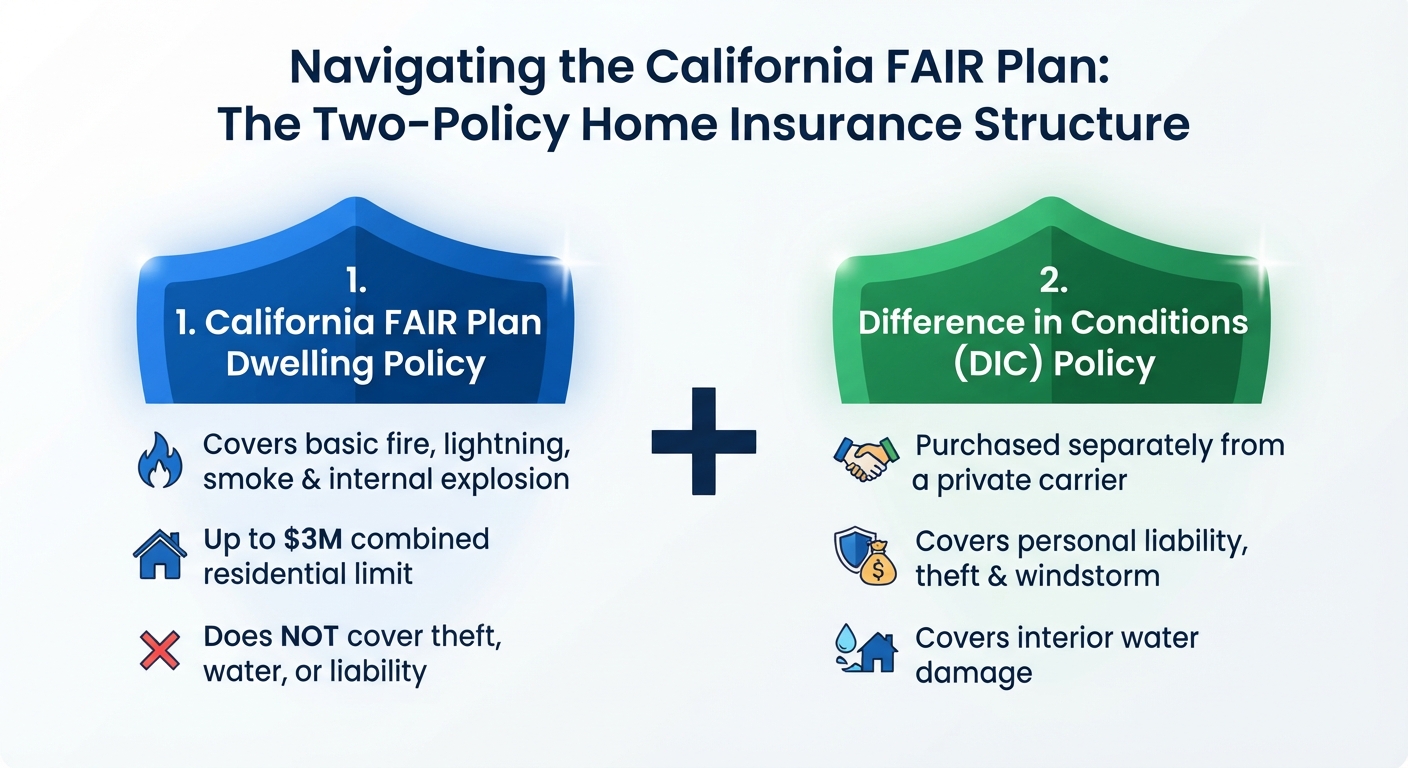
Homeowners must also remember the "two-policy structure" required when using the FAIR Plan:
The FAIR Plan Dwelling Policy: Covers only basic perils—fire, lightning, smoke, and internal explosion—up to a $3 million combined residential limit.
A Difference in Conditions (DIC) Policy: A separate policy purchased from a private carrier to cover liability, theft, windstorm, and interior water damage.
How Is the Insurance Crunch Affecting El Dorado County Home Prices?
El Dorado County home prices have held steady rather than declining, with median sale prices sitting around $677,000 to $678,750 in fall 2026, but insurance costs have lengthened days on market and created a clear divide between turnkey and unmitigated properties. Countywide single-family homes are averaging roughly 49 to 61 days to enter contract as inventory has expanded to a balanced 4.2-month supply.
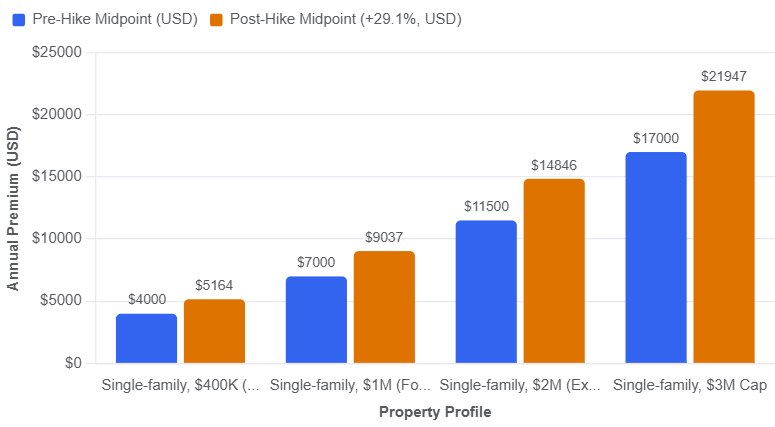
Rather than triggering a broad price drop, higher insurance premiums are reshaping negotiations in three ways:
Monthly Payment Compression: An extra $300 to $500 per month in combined FAIR Plan and DIC premiums directly reduces a financed buyer's purchasing power, making buyers more sensitive to overall monthly carrying costs.
Upfront Insurance Contingencies: Savvy buyers and agents now pull address-specific insurance quotes during the first week of escrow rather than waiting until the end of the inspection period.
Credits for Deferred Maintenance: Properties with older roofs, wood decks abutting siding, or heavy brush clearance needs frequently require seller closing-cost credits or price adjustments to offset first-year insurance expenses.
Practical Steps Foothill Homeowners Can Take Before Renewal
Homeowners can reduce their insurance costs by claiming up to 16.4% in FAIR Plan wildfire mitigation discounts, complying with new Zone 0 ember-resistant standards, and re-shopping private carriers 60 days before renewal. Because private admitted carriers and specialty surplus-lines insurers are gradually re-entering select foothill pockets, staying on the FAIR Plan without shopping each year can leave thousands of dollars on the table.
1. Claim All Available FAIR Plan Mitigation Discounts
El Dorado County holds an official Fire Risk Reduction Community designation from the California Board of Forestry. Combined with individual property upgrades, homeowners can stack discounts on the wildfire portion of their FAIR Plan policy:
Community Discounts: Living in an officially recognized Firewise USA neighborhood or Fire Risk Reduction Community qualifies for automatic percentage reductions—provided your insurance broker submits the certificate.
Immediate Surroundings (Zone 0): Clearing all combustible mulch, wood fencing touching the structure, and flammable plants within 5 feet of the home aligns with California’s newly approved Zone 0 standards and unlocks structural discounts.
Structure Hardening: Upgrading to a Class-A fire-rated roof, installing 1/8-inch or finer ember-resistant attic and crawlspace vents, and enclosing eaves can push total mitigation savings toward the 16.4% maximum.
2. Re-Shop Both Admitted and Surplus-Lines Markets
Under the state's Sustainable Insurance Strategy, major insurers—including Mercury, Allstate, State Farm, and specialty carriers like SageSure and Orion180—have filed or expanded programs to write mitigated California homes. Additionally, non-admitted surplus-lines policies grew from roughly 50,000 policies statewide in 2023 to over 320,000 by 2025, often offering broader single-policy coverage at competitive rates for well-maintained foothill homes. Working with an independent broker who has access to both admitted carriers and A-rated surplus-lines markets ensures you see every option before your renewal locks in.
Frequently Asked Questions (FAQ)
Can you get a mortgage in El Dorado County if a home only qualifies for the FAIR Plan?
Yes, virtually all conventional, FHA, and VA lenders accept a California FAIR Plan policy as long as it is paired with a Difference in Conditions (DIC) policy. Lenders simply require proof that basic fire coverage is bound through the FAIR Plan and that standard liability and water perils are covered under the companion DIC policy before closing.
Can I cancel my FAIR Plan policy mid-term if a private insurer offers me coverage?
Yes, you can cancel a California FAIR Plan policy at any time and receive a pro-rata refund of your unearned premium. However, you should never cancel your FAIR Plan policy until your replacement private or surplus-lines policy is fully underwritten and bound in writing.